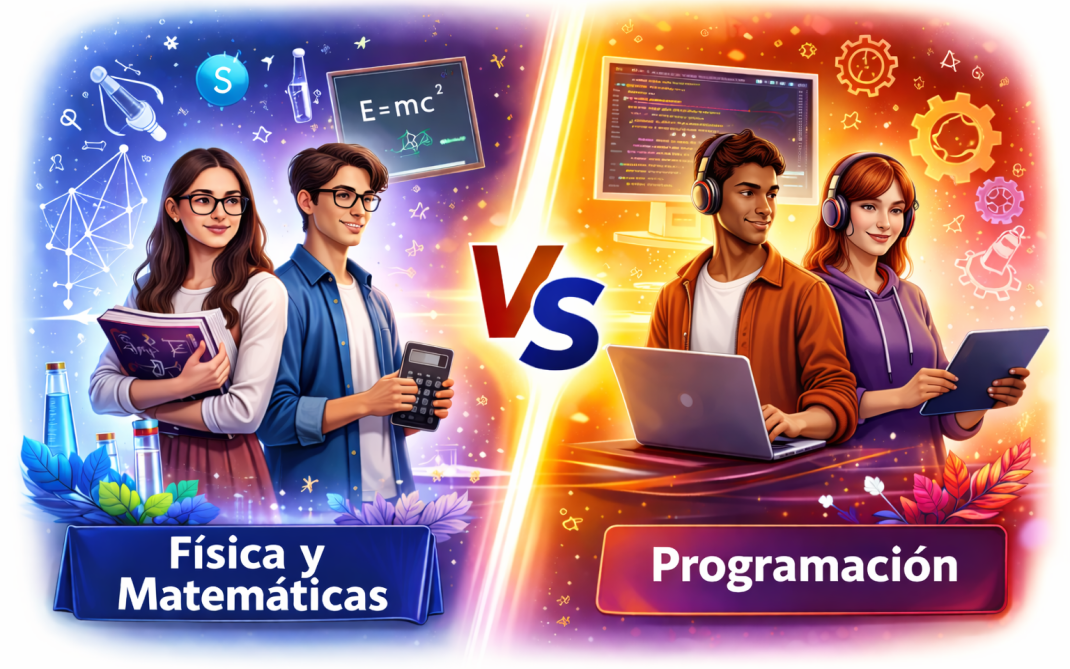
In 2025, Nvidia's CEO said that if he were a 22-year-old student today, he would not choose to study software or programming, but rather physical sciences because the future of artificial intelligence technologies will be increasingly linked to the real world and not just to algorithms. For him, the jobs of the future, especially those related to robotics and automation, will require knowledge of forces, dynamics and causality: something that cannot be learned through code alone.
For his part, Elon Musk got into a conversation on social networks about this, and also gave his opinion: "Physics (with math)", because he believes that it is in physics, along with mathematics, where deep reasoning lies. It is not the first time that Elon says that thinking based on fundamental principles (which is a way of reasoning from physics and mathematics), is the basis for solving complex problems in engineering and technology.
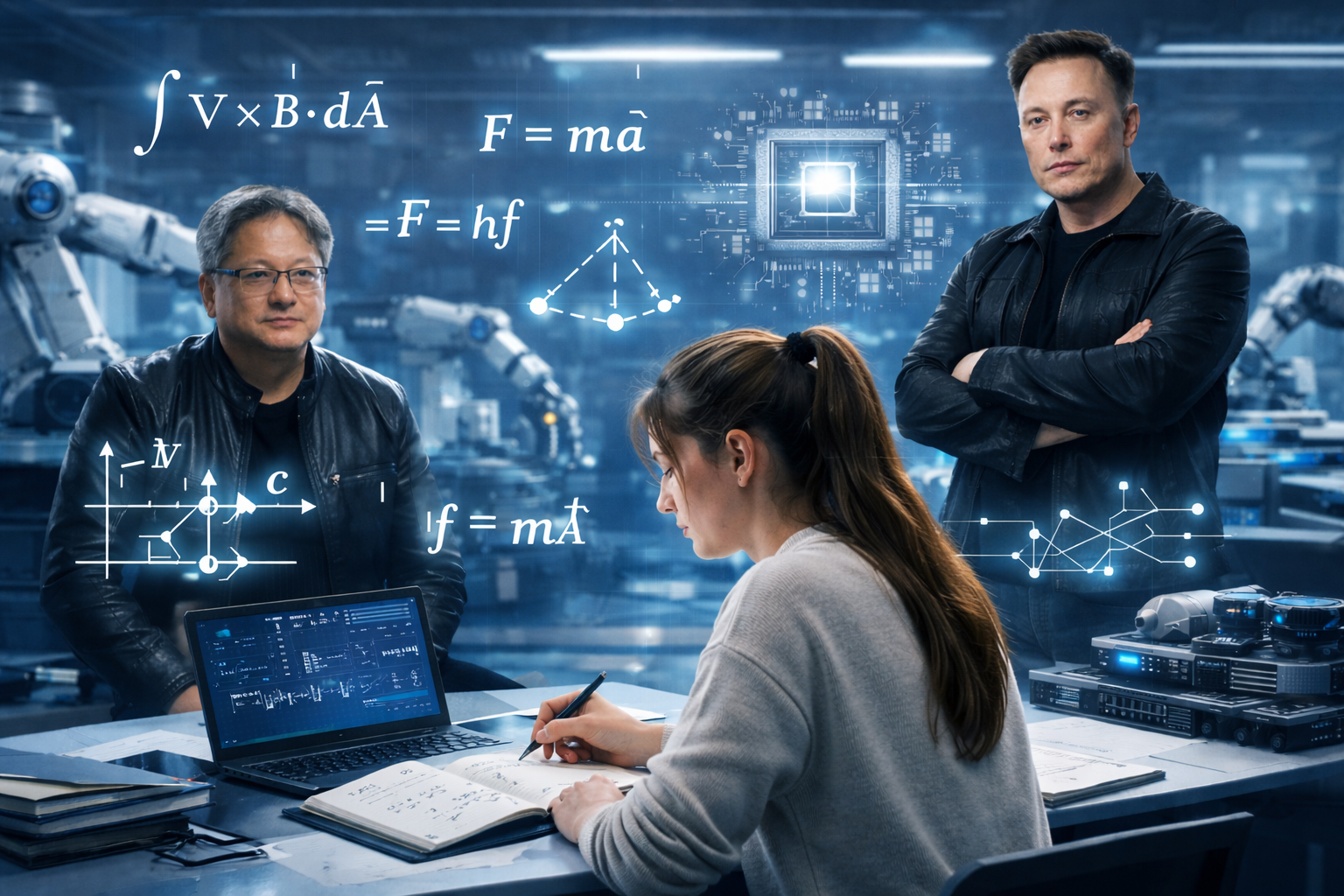
The message behind all this is that programming, while of course still useful, is becoming increasingly easy and automatable with AI tools that can write and debug code. And so, the advantage is going to go to those who understand the physical and mathematical world that those tools must model.For example, to create robotic systems such as autonomous vehicles or advanced manufacturing, it is not enough to know how to program: you have to understand how materials respond, how systems integrate, and so on. In other words, programming can be automated in many cases, but understanding the physical world requires other qualities.
You can imagine the educational impact this has: it is no longer so much about teaching more programming languages, but about training minds capable of posing complex problems, integrating knowledge and responding to the challenges of the physical and real world. Programming will continue to have value but will not go beyond being a practical skill to implement solutions. On the other hand, it will be the scientific capacity that will allow innovation and not just execution.
In short, the shared vision of Elon Musk and Jensen Huang speaks of a rather transformative new trend: AI automation relegates programming skills to an operational level, while the ability to understand and model the physical and mathematical world becomes a strategic advantage for young people. For vocational guidance this implies rethinking recommendations: moving from guiding in the simple use of technologies, to training to understand the principles behind them.
So, you know, the academic routes that combine physics and mathematics, including how they interact with technology and AI, will be the most attractive in the future job market. If you want to know where you fit best in the future, we can help.