Eight years of real-world guidance turned into knowledge
For years, we’ve seen how students, families, and schools are faced with an increasingly difficult decision: choosing a course of study in a job market that’s changing at a breakneck pace. Some degree programs still have familiar names, but the tasks, skills, and profiles that companies are looking for are undergoing a complete transformation.
That’s why this Barometer holds special value. It is based on an analysis of real-world career guidance processes conducted with more than 23,000 students who have gone through the Singularity Experts methodology. This allows us to observe something far more interesting than a general trend: it reveals what happens when the interests of real students intersect with emerging jobs and market trends.
The result is the Observatory of Vocations and New Employability, the first study to analyze how our career recommendations have evolved and how they connect with vocations and employability. The underlying question is a huge one: Can we know which career paths will make the most sense for young people before the market makes them obvious?
Our analysis points to a very compelling answer: yes, we can anticipate many of those paths when career guidance is data-driven and understands how new jobs emerge.
The Data That Changes Everything: Guidance Is Also About Anticipation
For a long time, career guidance has been viewed as a tool to help students choose among already known options: high school, vocational training, college degrees, and traditional career paths. That approach falls short when the job market begins to demand hybrid profiles, technological skills, critical thinking, adaptability, and the ability to move between sectors.
That’s why we talk about predictive capability. The Observatory analyzes the evolution of career recommendations over time, the alignment between current career paths and future jobs, the hybridization of profiles, accessibility through vocational training, and the lag with which university degrees often emerge relative to the market’s actual needs.
The underlying problem: there are jobs, but the connection is missing
The Barometer was created against a very serious backdrop. Spain ended 2025 with a youth unemployment rate of 23%, according to sources such as the INE and Eurostat, while thousands of job openings remain unfilled and many companies continue to face difficulties in hiring qualified candidates. At the same time, the SEPE has been highlighting a complex reality for years: many job postings receive applications that are poorly matched to the training required for the position.
This mix creates a paradox that is difficult to reconcile: young people eager to build their future, families trying to support them effectively, schools doing a tremendous job with limited resources, and companies seeking talent that often arrives too late, is misaligned, or has training that is poorly connected to what’s happening in the real world.
The Barometer focuses on that middle ground: the connection between vocation, career guidance, and the labor market. Much more is decided there than meets the eye. Good career guidance helps students understand what they’re good at, what truly motivates them, what educational paths are available to them, and what jobs might emerge that align with their profile in the coming years.
The key lies in looking at the decision more deeply. Choosing a degree program based on a well-known major, a minimum admission score, or a traditional career path may seem like the norm, but today’s market demands a different perspective: evolving job roles, professions that are merging, emerging sectors, and skills that are rapidly gaining value.
An event to move from intuition to responsibility
Presenting this Barometer at the event “Futures That Never Arrive.” From Intuition to Responsibility, in partnership with Fundación Telefónica and OrientaHub, makes perfect sense. Because young people’s professional futures deserve something more serious than a recommendation based on the status quo, on what sounds familiar, or on what someone studied twenty years ago.
Career guidance needs to become a tool for anticipation. And that means asking more uncomfortable questions: Which jobs are growing? Which tasks are becoming less important? Which skills will make a difference? Which degree programs are arriving too late to the market? And which options can open up real opportunities for each student?
The Barometer shows that this foresight is possible four or five years down the road when career interest data is cross-referenced with labor market signals. That is Singularity Experts’ greatest contribution: transforming thousands of career guidance processes into structured knowledge to help people make better decisions.
For families, this means being able to provide more informed guidance. For students, it means discovering careers they may never have imagined—ones that align with their interests, their strengths, and a job market that is already changing. For schools, it means having a more up-to-date view of employability and the emerging educational pathways.
And for us, it means one thing very clearly: providing effective career guidance today requires looking far beyond the name of a degree program.
Come learn about the findings
The Career Paths and New Employability Barometer was created to use data to demonstrate an idea we’ve been developing for years at Singularity Experts: the professional future can be anticipated when career guidance combines method, technology, labor market analysis, and a deep understanding of each student.
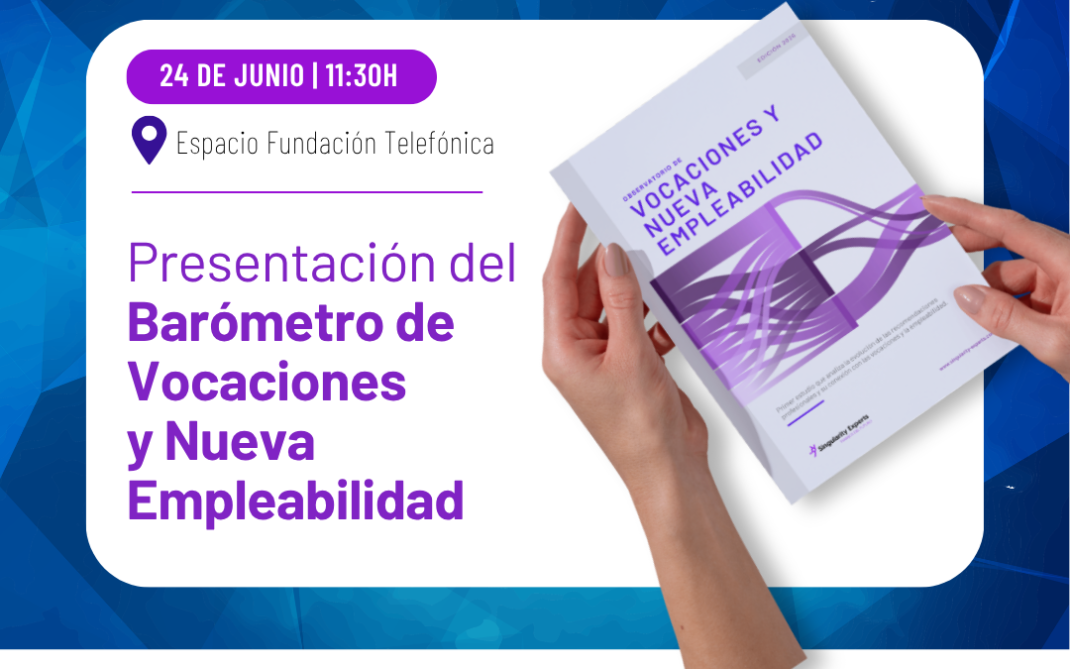
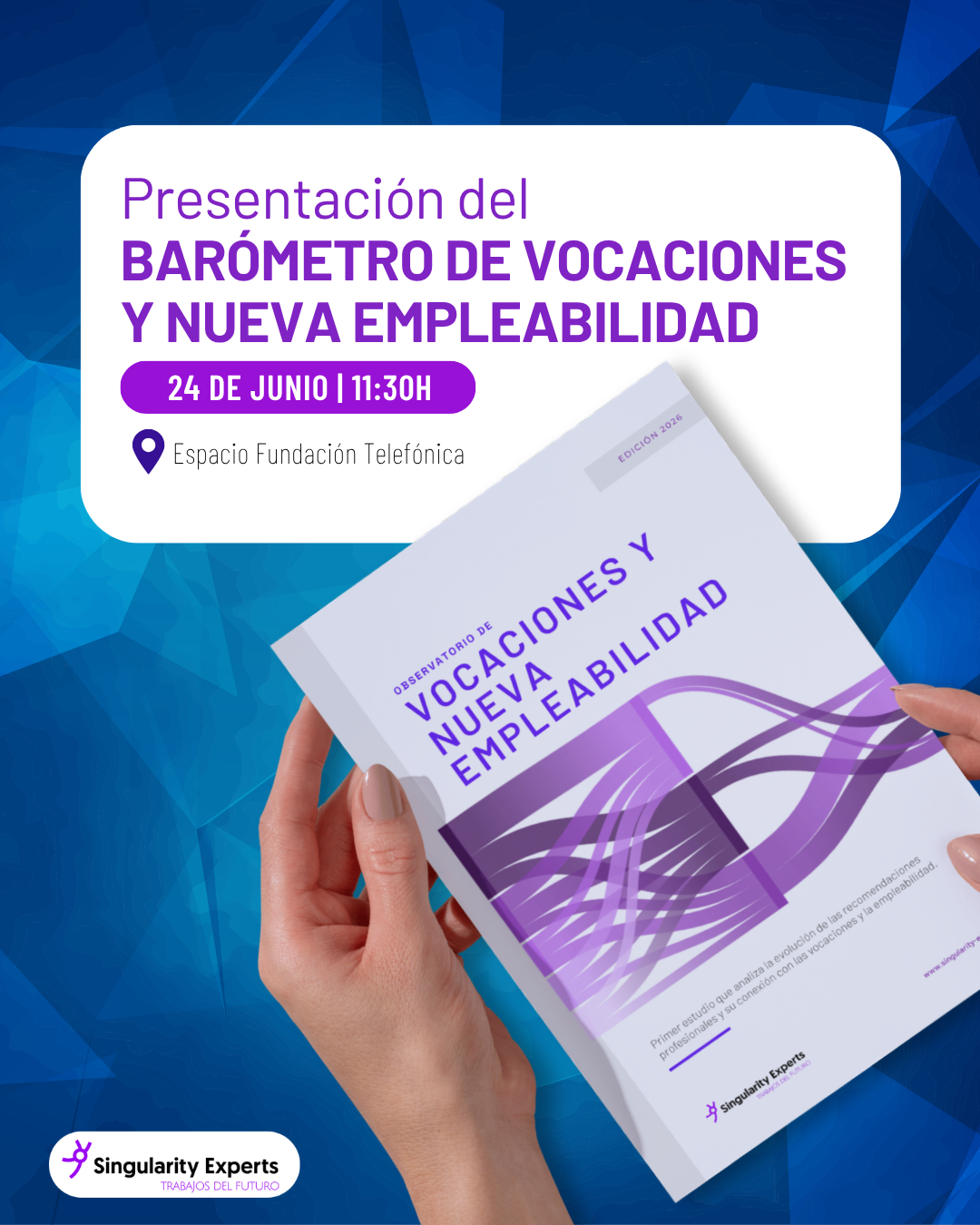
We’ll present its main findings on June 24 at 11:30 a.m. at Espacio Fundación Telefónica, as part of the event “Futures That Never Arrive: From Intuition to Responsibility.” This will be an opportunity to understand what eight years of career guidance analysis reveals when compared to the real labor market, which jobs are gaining prominence, and how we can help young people make more informed decisions.
We look forward to seeing you there to learn firsthand about the data, conclusions, and key insights from this first Vocational and New Employability Barometer.