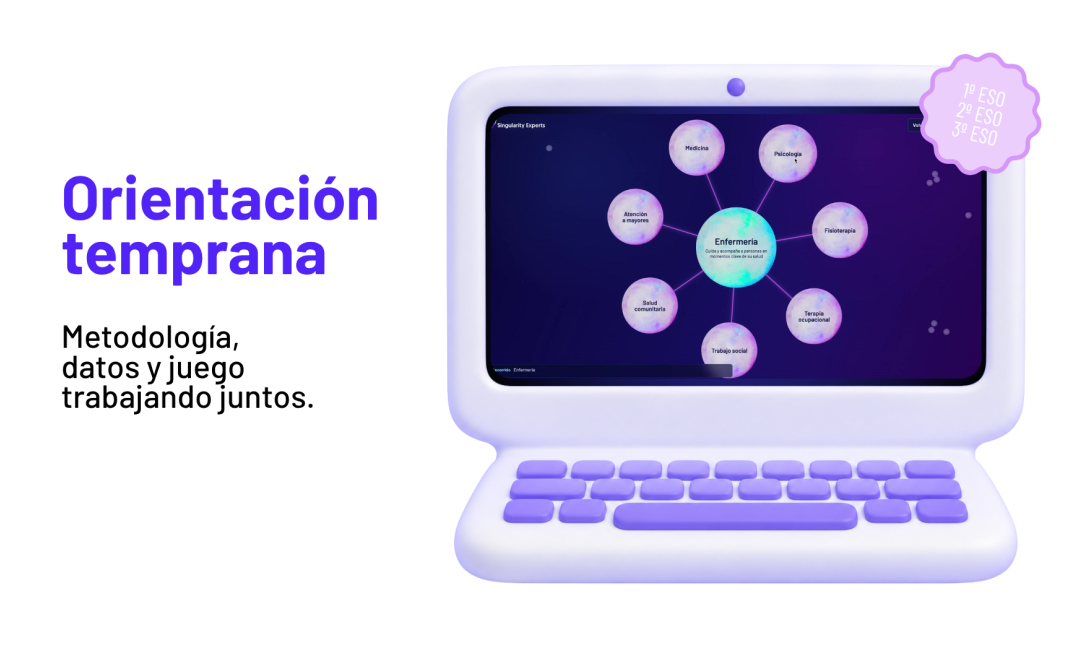
Early career guidance helps you learn to make decisions
When we talk about early career guidance, we’re talking about starting to develop—from the earliest years of secondary school—something that will later carry tremendous weight: the ability to connect who I am, what I’m good at, what interests me, and what opportunities exist out there.
The OECD itself has spent years analyzing the relationship between teenagers’ career aspirations and their future. One recurring problem is that many young people focus their expectations on a narrow range of professions, while the job market evolves and new career paths emerge that are barely part of their imagination.
In our own Barometer of Careers and New Employability, we’ve reached a conclusion closely tied to this idea: choosing a course of study works much better when students first understand which activities suit them, which jobs are growing in those fields, and which educational paths can lead them there.
That’s why it makes sense to start early. Between the ages of 12 and 16, there’s a wonderful window of opportunity to explore at a leisurely pace, experiment, discover interests, and broaden one’s horizons. Each activity adds a small piece that later helps students make much bigger decisions.
Early career guidance also needs to be engaging
Asking a student in the 1st or 2nd year of ESO to seriously consider what they want to study several years down the road is unlikely to go far. At that age, it works much better to present them with situations they can understand, let them play with possibilities, and allow them to discover things about themselves almost as an aside.
That’s the logic behind our new early career guidance activities for 1st, 2nd, and 3rd years of ESO. We’ve turned skills, career challenges, and academic decisions into interactive experiences tailored to each grade level.
A card -matching game can help students discover and develop skills. A challenge like a large-scale climate-driven migration allows them to face a complex problem and think about how to tackle it. A career path simulator helps students see how certain interests can connect with different academic options. And a career exploration tool can introduce students to jobs that have never come up in conversations at home or in class.
That last point is quite significant. In our analysis of how career guidance affects young people’s career aspirations, we already explained the extent to which students’ expectations can become focused on well-known professions. Exploration broadens that horizon and allows for the inclusion of possibilities that weren’t even on the table before.
From Self-Awareness to Understanding a Changing Professional World
Early career guidance makes even more sense when we look at what’s happening outside of school. AI, automation, sustainability, and interdisciplinary approaches are changing the tasks many professionals perform and creating new ones.
This changes a significant part of the career guidance process. Students need to know themselves and, at the same time, understand the world they will enter. These two pieces gradually come together: skills, interests, motivations, academic subjects, real-world challenges, emerging jobs, and educational pathways.
For example, an activity on climate change can spark an interest in solving environmental problems. From there, skills related to that challenge emerge, along with professions that address it and academic programs that lead to those careers. Guidance counseling thus gains continuity and meaning for a teenager because each discovery leads to the next.
Furthermore, the job market is changing even at the very threshold of employment. In the article on how AI is transforming young people’s first jobs, we analyze how many tasks traditionally assigned to entry-level positions are evolving due to automation. This makes it even more important to develop critical thinking, creativity, problem-solving skills, digital competencies, and a good understanding of one’s own profile from an early age.
Guidance that grows alongside the student
Providing career guidance starting in the 1st year of ESO allows us to build a progressive path. At age 12, we can start by exploring interests, skills, and ways to participate in a team. Later on, we can introduce major challenges, connect academic subjects with interests, explore careers, and—when the first major academic decisions arise—use that entire journey to make much more informed choices.
The school also gains a valuable tool: guidance becomes an ongoing educational process that can be integrated throughout the school year and allows teachers to support students’ development with age-appropriate activities.
This approach also aligns with a reality we see constantly at Singularity Experts: the professional world is evolving at an enormous pace, and the education system needs mechanisms to bring those changes closer to students. Our digital guidance methodology was selected by the OECD as a success story in its ODiCY observatory, which is dedicated specifically to the use of digital technologies in the academic and career guidance of young people.
Starting early gives us something very valuable: time. Time to discover, try things out, change our minds, broaden our horizons, and gradually understand the relationship between what each student brings to the table and a job market that will continue to transform.
At Singularity Experts, we have designed our activities and guidance packages to make this journey practical, from the early years of secondary school through to decisions about high school, vocational training, or college. That way, when the time comes to choose, students have many more resources to build their own path, and the school can support them with a methodology, data, and tools specifically designed for this purpose.
Start Career Guidance from the Early Years of ESO
If you’d like to incorporate early career guidance at your school, we’ve prepared activities for the 1st, 2nd, and 3rd years of ESO that help students develop skills, explore career challenges, discover new possibilities, and learn to make decisions progressively.
These are ready-to-use classroom activities, designed so that teachers can easily implement them and students can learn while exploring their future.
→ Request information about our early career guidance activities here