
A convincing answer might sound like a professional recommendation
Let’s imagine that a high school student majoring in the social sciences tells ChatGPT that she’s interested in human well-being from a scientific perspective. Since generative AI bases its recommendations on probabilities, it will likely end up suggesting medicine, bioengineering, or something along those lines. And it will explain with “great confidence” why each option might interest her. But… can generative AI take her personality into account? Can it access her values and her work style? Is it capable of linking the student’s cognitive abilities to the tasks involved in each profession? What actually caused one option to appear ahead of another?
Generative AI creates responses based on the information it receives, drawing on probabilities derived from previous texts. When we ask it to recommend degree programs, the selection it makes depends on what it has previously “read” in millions of texts; and if it has read that human well-being, from a scientific perspective, is related to medicine, the system will interpret that there is a high “probability” that this is the correct recommendation.
To recommend accurately, you have to measure and weigh factors
An algorithmic guidance system, on the other hand, starts with structured information about the student and data on current jobs. It then compares both profiles and calculates, in a controlled manner, which professions best match the student’s characteristics. This control is maintained at all times, because the variables that matter for each job—and the weight assigned to each—have been defined in advance. Who defined them? People: psychologists, guidance counselors, and human resources experts—never AI. In our methodology, for example, we consider interests, cognitive aptitudes, personality traits, career interests, competencies, computational thinking, values, and affinity for specific sectors and technologies... Since each job requires a different combination of these traits, the system assigns reference scores to these dimensions and weights their importance not only according to the profession but also according to the student’s personal combination of traits. And that is why AI can compare options based on these reliable criteria and rank recommendations by degree of fit, within a fully controlled environment.
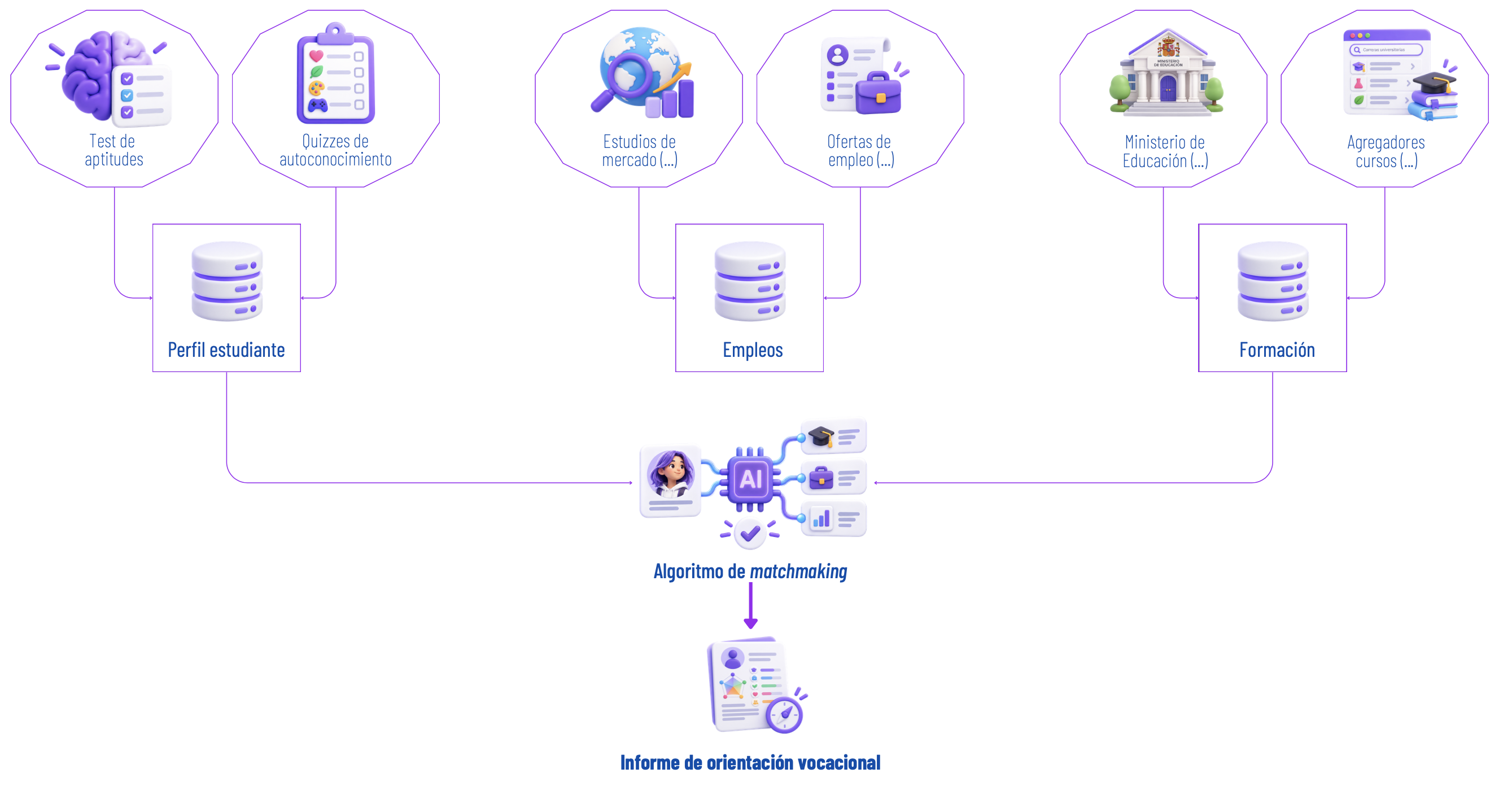
Let’s return to the social sciences student interested in human well-being through science. The description she provided leads the generative AI to directly recommend medicine or bioengineering. But when the algorithmic AI measures other dimensions of her profile and uncovers traits such as abstraction, crystallized intelligence, computational thinking, and transhuman values, it detects much more specific and illuminating connections regarding her potential: this student likes to understand well-being through theoretical models, is interested in making sense of those models, and has the skills to translate them into automated systems. This is not Medicine.
This data provides much more insightful information, opening up paths such as the Humanities, Philosophy and Technology, or the Ethics of Artificial Intelligence. Consequently, it can recommend college majors such as the Bachelor’s Degree in Science, Technology, and the Humanities; the Bachelor’s Degree in Philosophy, Politics, Law, and Economics; the Bachelor’s Degree in Digital Society Management; the Bachelor’s Degree in Digital Humanities and Artificial Intelligence; or the Bachelor’s Degree in Transformative Leadership and Social Impact. These options—unknown not only to the student and her family but also to her guidance counselors—are not only relevant to her high school studies but also offer excellent career prospects.
Therefore, the difference between the two AIs lies in how the recommendation is constructed: the recommendation changes depending on the weight assigned to each piece of data. If the student’s expressed interest accounts for almost the entire assessment, she will primarily see professions that are directly related to that interest. But by incorporating skills, personality, values, and job characteristics, new options emerge that aren’t initially as obvious but align much better with her profile. This is why weightings are so important—they help determine what factors are considered and how much each influences the recommendation’s outcome: a personality trait can modulate the effect of a cognitive skill, a student’s values can reinforce the importance of a career interest, and so on. Thus, each dimension influences the others, and the recommendation reflects the complete profile.
When Generative AI Helps and When Caution Is Advised
Generative AI can explain what a job entails, describe what a typical day in that profession is like, or help prepare questions for a career counseling session. It can also introduce students to careers they are not yet familiar with and serve as a tool to help them explore their interests. Caution is needed when we ask it to advise a young person on what they should study and to rank their options.
UNESCO recommends validating generative AI tools and maintaining a people-centered approach in education. In career guidance, validating a tool also involves asking how it calculates its recommendations and which professionals oversee its criteria.
For this reason, Singularity Experts recommends using algorithmic AI over generative AI. This is because a chatbot can explain options, describe professions in accessible language, and help students explore new questions. However, the calculation of the recommendations itself follows the model defined by experts: its variables, relationships, and weightings.
At Singularity Experts, we work to ensure that every student can connect their interests and strengths with real-world careers and specific educational paths. Our guidance packages help families and students explore these options with a recommendation built on defined, weighted, and reviewable variables.
If you’d like to learn more about how we work, please contact us.