
What the McKinsey Study Says
The report *Workforce in Motion: Skills and Pathways to Future Jobs in the United States* has just been published, analyzing how the U.S. labor market could change through 2035. Here are some of its findings:
- Workers without a college degree are nearly twice as likely to need to change careers.
- 84% of growing occupations require post-secondary education.
- The number of occupations requiring skills to work with AI has increased approximately elevenfold since 2022.
- AI could create between 500,000 and 2 million jobs in new occupations or those that are still too small to measure.
- More than 70% of workers may need to reinvent themselves to some degree within their current jobs.
McKinsey recommends aligning training with growing occupations and labor market needs.
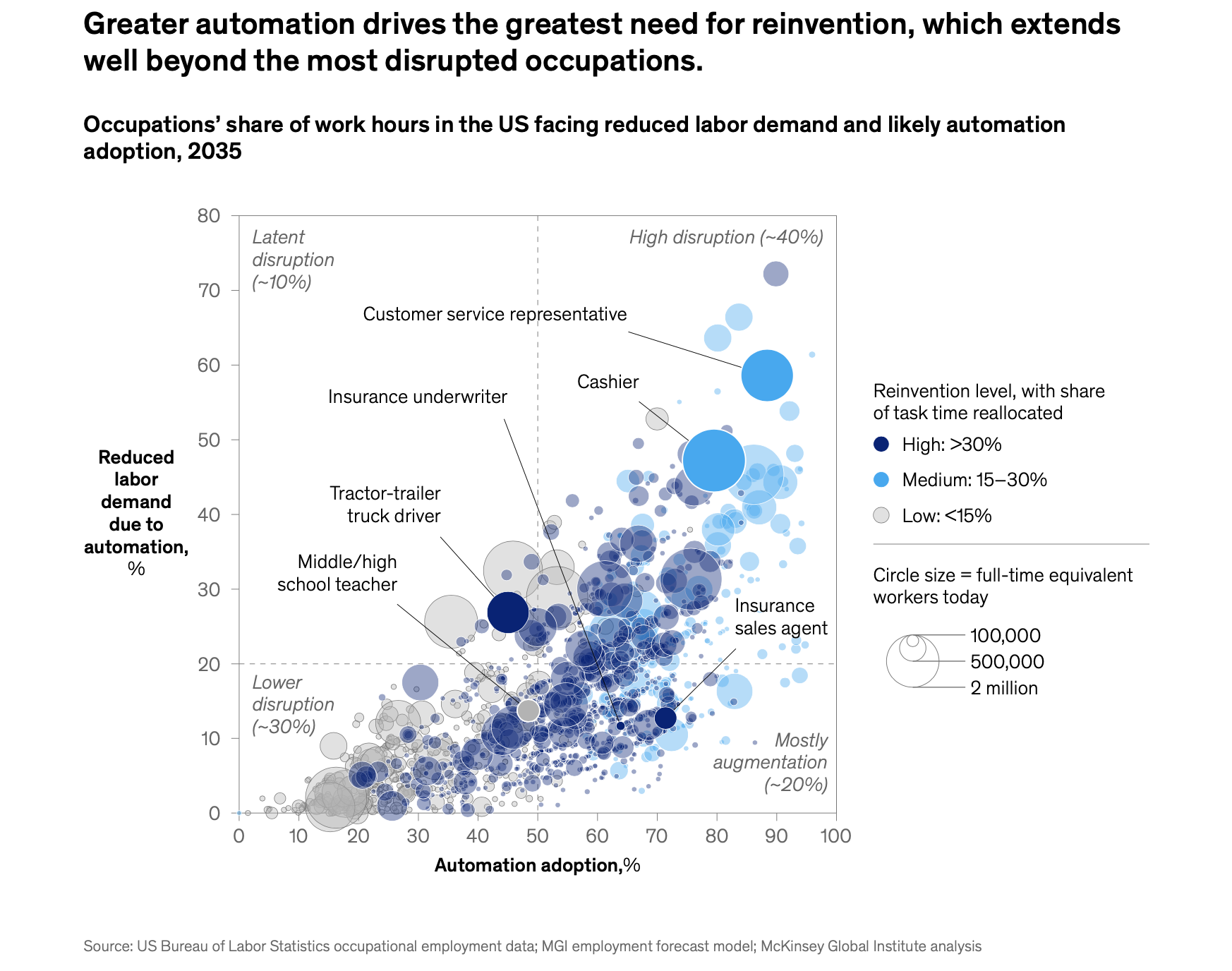
Source: McKinsey 2026 Report “Workforce in Motion: Skills and Pathways to Future Jobs in the United States”
What Conclusions Do We Draw?
Although the study focuses on the United States, it raises very important questions for training and career guidance in Spain. At Singularity Experts, we highlight four:
- Training deserves even more attention than before. Many college graduates will have to learn to practice their profession differently, while those with less training face a greater risk of needing to change careers. That’s why it’s so important to choose wisely what to learn and to keep updating your skills.
- We need to provide training in AI from an early age. This doesn’t mean having children use it from a young age; rather, it means understanding how it works, verifying its responses for future use, and learning to apply it judiciously. A student needs their own knowledge to evaluate what a tool suggests and decide how to use it.
- The transformation of the workforce may widen the gap between those with more and fewer opportunities for training. In our view, providing training and guidance starting in school should be a priority to help young people prepare well in advance.
- We need career guidance that is much more focused on the jobs of the future. When choosing a field of study, it’s important to understand what tasks a person will perform, which ones are being automated, and which skills are becoming more important. As we explained when analyzing four degree programs whose career paths are changing due to AI, the same degree can lead to jobs with very different prospects.
How to apply these conclusions to choosing a course of study:
For us, the practical implication is clear: career guidance must keep pace with the transformation of work. The automation of tasks increases the value of understanding problems, making decisions, and evaluating results—an issue we also addressed when discussing physics and mathematics versus programming.
Choosing a major simply because it’s reputed to offer good career prospects can lead to overlooking these changes. That’s why, in our career guidance packages for students and families, we connect each student’s interests and abilities with emerging jobs and educational pathways. If you’re deciding what to study, we’ll help you translate all this information into concrete options and a path that’s right for you.